Tested Truth may earn a commission when you buy through links on this page, at no extra cost to you. This does not affect our ratings.
Businesses rely on rating-based questionnaires to capture sentiment, satisfaction, and employee opinion in a form they can measure. Using a likert scale survey monkey setup, teams can present standardized multi-point rating grids that turn subjective feelings into numbers. Getting the response options balanced is the foundation of trustworthy data, whether the audience is internal staff or outside customers. Here we examine how well this software handles scaled opinion collection so you can judge whether it fits your research plans.
Rating questionnaires must respect respondents' time while still producing data that holds up under reporting. Choosing a sensible survey tool keeps participants engaged and ensures the results point toward decisions you can actually act on.
Quick verdict: SurveyMonkey earns a Tested Truth score of 7.9 out of 10. It suits teams that need consistent feedback templates and simple matrix questions. It is a weaker fit for groups that need dedicated academic statistical packages without relying on external export tools.
| Metric | Summary Details |
|---|---|
| Tested Truth score | 7.9 / 10 |
| Best for | Organizations wanting standardized opinion measurement and matrix rating grids |
| Not ideal for | Researchers requiring offline manual questionnaire administration |
| Key strengths | Standardized rating matrices, customizable label anchors, and clear visual response summaries |
| What to check before buying | Confirm data export formats and administrative seat allocations on the official vendor site |
1. How Tested Truth Reviewed SurveyMonkey
This review considers what SurveyMonkey is built to do, who it serves, and how it stacks up against comparable tools. We used seven Tested Truth criteria: features, ease of use, pricing and value, integrations, audience fit, support, and competitive position. Plans, prices, and limits change frequently, so we flag what to confirm on the official website before purchasing. This article was researched and drafted with AI assistance, then reviewed and edited by the Tested Truth Editorial Team.
2. What SurveyMonkey Is and Who It Serves
SurveyMonkey is a web-based survey platform for building, sending, and analyzing questionnaires. It lets people gather quantitative and qualitative feedback from varied audiences without writing code. Because organizational choices increasingly rest on structured sentiment, a likert scale survey monkey deployment offers consistent measurement across repeated intervals.
The platform is used mainly by business managers, HR staff, educators, marketing strategists, and student researchers. Teams looking to improve broader Customer Service metrics often use Likert matrices to assess support interactions, clarity of communication, and how effectively issues are resolved.
Standardized matrix layouts let evaluators compare agreement, frequency, satisfaction, and importance across recurring review cycles.
3. Core Features for Rating Scales and Surveys
Matrix Question and Scale Formatting
Standardized scales depend on precise label setup and consistent row alignment. The software lets authors build multi-row rating grids where respondents rate several statements against one shared scale. Designers can choose odd-numbered scales with a neutral midpoint or even-numbered forced-choice formats, depending on the research goal.
Labels can be tailored to express agreement, frequency, satisfaction, or likelihood. Buyers evaluating matrix functionality should check on the official SurveyMonkey website how complex tables display on phone screens, so participants aren't forced into horizontal scrolling.
Response Collection and Distribution
Distribution determines how questionnaires reach the intended respondents. The software offers several collection routes, including web links, embedded email invitations, website pop-up prompts, and digital kiosks. Collecting responses in a systematic way helps ensure the sample reflects the demographic balance you are aiming for.
Project managers can set completion rules, response validation, and required-answer toggles to limit incomplete submissions. Verifying collector settings on the official platform makes sure data gathering matches your organization's communication policies.
Data Analysis and Visual Reporting
Turning individual rating choices into usable organizational insight requires clear analytical reporting. The platform rolls matrix responses into automated frequency distributions, weighted average scores, and percentage breakdowns. Visual charts show how answers spread across each scale anchor, making strong agreement or negative feedback easy to spot.
For deeper statistical work, cross-tabulation tools let teams filter results by respondent attributes. When advanced modeling is required, confirm the supported export formats on the official SurveyMonkey site so the data moves cleanly into external quantitative software.
4. Ease of Use and Learning Curve
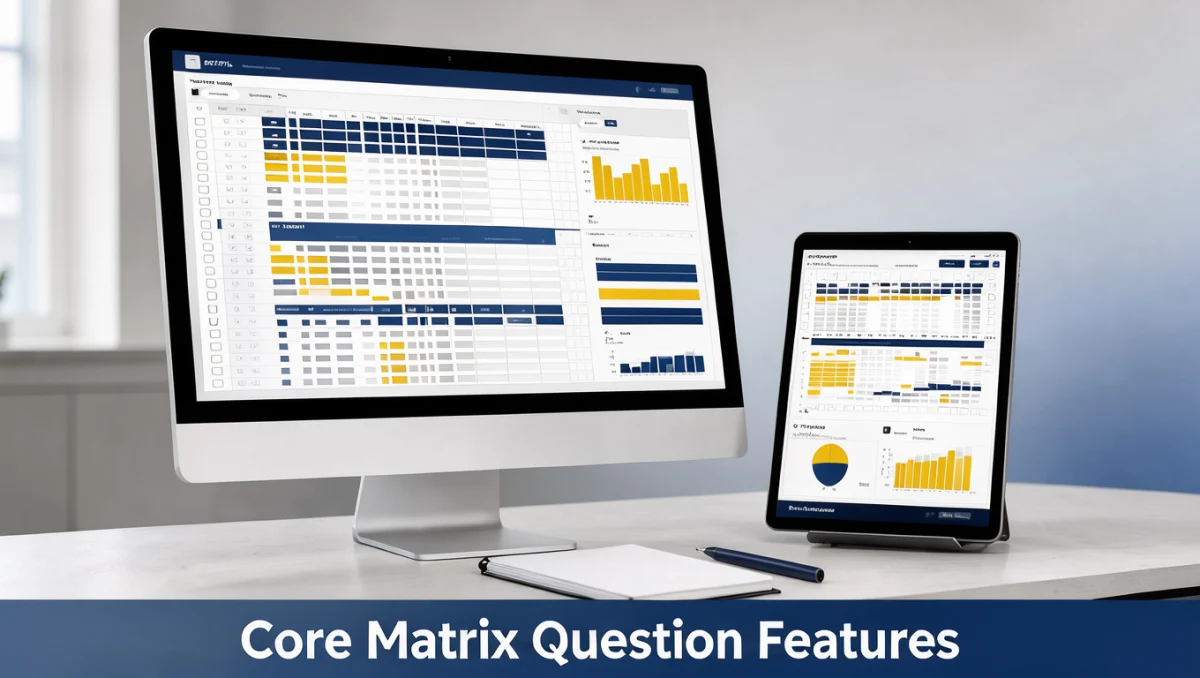
Setting up Likert matrix items is straightforward, even for people new to formal survey design. Pre-built question banks and suggested scale labels help creators assemble coherent surveys in minutes. The drag-and-drop interface simplifies reordering items, adjusting point values, and editing introductory instructions.
First-time users can move through the survey creation menus without extensive training. However, very long matrix blocks can cause respondent fatigue, so authors should keep questionnaires concise. Following standard survey methodology also prevents poorly worded anchor statements that could distort the results.
5. Pros and Cons of Using SurveyMonkey for Likert Surveys
Pros
- Intuitive matrix question setup that makes it quick to configure standardized rating options.
- Automated calculation of weighted averages across multi-point agreement scales.
- Flexible distribution options that reach respondents across different digital touchpoints.
- Clear visual summary charts that make executive presentations straightforward.
Cons
- Large matrix tables may require horizontal scrolling on narrow smartphone screens; buyers can check this by previewing layouts at different screen sizes.
- In-depth academic statistical modeling often requires exporting raw data into external statistical software.
- Seat permissions and response limits vary by tier, so confirm them on the vendor pricing page before committing.
6. SurveyMonkey vs Similar Survey Platforms
Knowing the alternatives helps buyers pick a tool suited to their research complexity. Platforms such as Qualtrics target enterprise research teams that need advanced statistical testing, complex branching logic, and academic-grade psychometric modeling. SurveyMonkey strikes a more accessible balance, suited to everyday business feedback and departmental pulse checks.
Typeform focuses on conversational, one-question-at-a-time formats that engage respondents visually, though it presents multi-item matrix grids less compactly. Google Forms covers basic data capture with no subscription cost, but offers fewer pre-built psychometric templates. Reviewing each provider's stated research scope on its official pages will show which focus matches your team's capabilities.
7. Who Should Use SurveyMonkey
Freelancers and Independent Consultants
Independent professionals running client satisfaction audits or collecting project milestone feedback benefit from fast questionnaire deployment. Pre-configured templates cut setup time, letting consultants produce polished assessments without heavy design work.
Small Business Owners and Office Managers
Small teams tracking customer loyalty, workplace culture, or service performance find structured rating grids useful for quarter-over-quarter comparisons. Watching sentiment trends helps leadership address operational bottlenecks before they grow.
Marketing Teams and Product Researchers
Marketers testing concept appeal, brand sentiment, or feature importance can send targeted rating scales to specific customer groups. Visual trend charts make it easy for marketing leads to share consumer preferences with product and executive stakeholders.
Teams That Should Consider Other Options
Organizations that need offline paper-based scanning or advanced multivariate statistical modeling may find basic digital survey tools limiting. In those cases, dedicated statistical software or enterprise research suites provide deeper analytical capability.
8. How to Choose the Right Plan for Rating Scale Projects
Survey software pricing depends on organization size, number of collaborator seats, and response volume. Readers comparing survey solutions across Tested Truth can use the checklist below to evaluate plan tiers before subscribing.
| What to check on the official site | Why it matters for rating scales |
|---|---|
| Data export capabilities | Ensures raw numerical responses can be processed in spreadsheet or statistical tools |
| Administrative seat limits | Determines how many team members can edit matrix questions at the same time |
| Response collection thresholds | Prevents unexpected overage charges or halted surveys during critical collection windows |
| Advanced filtering and cross-tabulation | Enables comparing rating scores across distinct demographic segments |
9. Frequently Asked Questions
What makes a five-point scale different from a seven-point scale in survey design?
A five-point scale strikes a good balance between ease of decision-making for respondents and enough granularity for researchers. A seven-point scale offers greater sensitivity to subtle shifts in opinion, which suits academic or specialized sentiment research. Teams should weigh whether respondent fatigue outweighs the need for finer statistical distinctions.
Should survey designers include a neutral midpoint in rating grids?
A neutral midpoint lets respondents with no strong feelings answer honestly without skewing the data. Removing it forces participants to lean positive or negative, which can introduce artificial bias when people genuinely have no preference. Reviewing your study objectives helps determine whether forced-choice questioning is statistically appropriate.
How does an odd-numbered scale compare to an even-numbered scale?
Odd-numbered scales include an explicit middle category, often labeled neither agree nor disagree. Even-numbered scales remove this center point to discourage fence-sitting. The right choice depends on whether you want to capture indifferent opinions or push respondents toward a directional stance.
What causes respondent drop-off in matrix rating surveys?
Presenting too many statements in one matrix block often leads to cognitive fatigue and abandoned surveys. Participants facing repetitive grids may select the same rating down the column without reading each statement carefully. Keeping question blocks short and randomizing item order helps protect response quality.
10. Final Verdict
Using Likert scale questionnaires in SurveyMonkey gives organizations a dependable way to turn subjective sentiment into structured metrics. The platform simplifies grid creation, offers flexible label options, and produces easy-to-read visual summaries for operational reviews.
| Evaluation Criterion | Assigned Score | Assessment Details |
|---|---|---|
| Features | 8.2 / 10 | Matrix questions, custom scale anchors, and automated weighted averaging meet standard requirements |
| Ease of Use | 8.8 / 10 | Intuitive questionnaire creation tools minimize onboarding time for non-technical users |
| Pricing and Value | 7.2 / 10 | Buyers should verify response caps and user seat limits on official pages to validate budget alignment |
| Integrations | 7.8 / 10 | Export flexibility allows transferring response datasets into external reporting workflows |
| Audience Fit | 8.5 / 10 | Well aligned with corporate administrators, marketers, educators, and service managers |
| Support | 7.0 / 10 | Support access channels depend on plan level, which buyers must verify on the vendor site |
| Competitive Position | 8.0 / 10 | Remains a widely recognized option balancing functional scope and straightforward deployment |
Overall Tested Truth Score: 7.9 / 10
For teams that want practical sentiment measurement without a steep learning curve, SurveyMonkey provides a dependable foundation. Organizations with complex psychometric requirements should verify export depth and analytical options before making a purchase decision.
Readers with specific survey software questions can reach us through our contact form or follow the Tested Truth team on LinkedIn for ongoing software evaluations.