Some links on this page are affiliate links. Tested Truth may earn a commission when you buy through them, at no extra cost to you, and this does not influence our ratings.
Finding the right published study quickly is a daily challenge for clinicians and medical researchers. Tools built for consensus AI for healthcare professionals aim to shorten that search by pulling findings straight from academic papers. Our team at Tested Truth assessed this category by looking at how each platform handles evidence discovery, interface usability and fit with real research habits, so readers can pick software that matches their workflow.
Medical environments depend on transparent sourcing and repeatable results. Platforms in this space do not diagnose patients or replace bedside judgement; their purpose is to index scientific literature and summarize what published studies conclude. Many people first encounter these platforms while browsing the broader Artificial Intelligence category, where summarization tools are increasingly used for early-stage literature reviews, grant background and policy drafts.
Quick verdict: Consensus AI earns 7.7 out of 10 for healthcare professionals who want fast literature discovery. It suits medical researchers, clinicians preparing reviews and academic staff who need structured evidence summaries. It is a weaker match for practitioners looking for point-of-care diagnostics or direct patient record integration.
| Metric | Summary |
|---|---|
| Tested Truth score | 7.7 / 10 |
| Best for | Clinicians and researchers who need quick access to scientific literature summaries |
| Not ideal for | Practitioners seeking direct point-of-care medical advice or automated patient charting |
| Key strengths | Question-based evidence extraction, citation linking and consensus-style aggregation of published findings |
| What to check before buying | Confirm search quotas, seat licensing and institutional repository access on the official plan pages |
1. How Tested Truth Reviewed Consensus AI
This review examines what Consensus AI is designed to do, who it serves and how it compares with similar tools. We applied seven criteria: features, ease of use, pricing and value, integrations, audience fit, support and competitive position. Plans and prices change frequently, so we flag the details you should verify on the vendor's website before committing. The article was drafted with the help of AI tools and then reviewed and edited by the Tested Truth Editorial Team.
2. What Consensus AI Is and Who It Serves in Healthcare

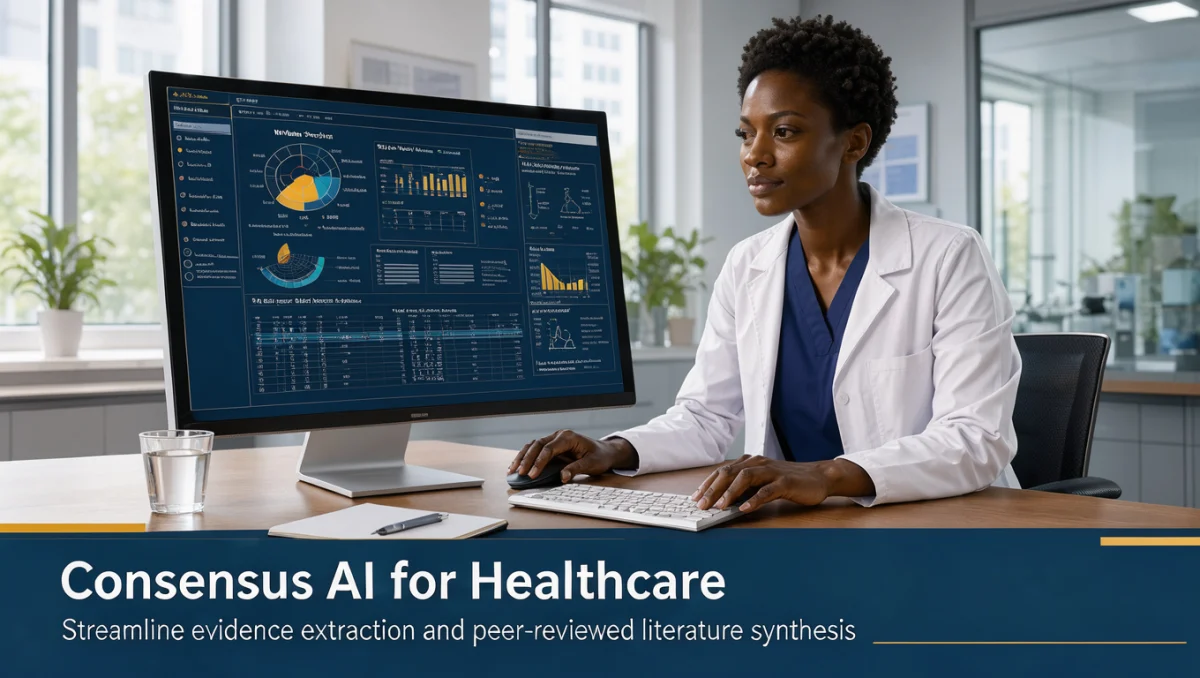
Consensus AI is an academic search engine that uses language models and citation indexing to synthesize research papers. It covers peer-reviewed studies across biology, medicine, social sciences and public health, and presents conclusions drawn from the published papers themselves rather than from general web pages.
Because the medical literature grows constantly, manually scanning journal indexes takes significant time. The platform is aimed at physicians, nurses, clinical trial specialists, medical educators and health policy analysts who ask specific questions and want to see how studies agree or disagree. A natural-language question about treatment outcomes or biochemical mechanisms returns a summary alongside links to the original publications.
Remember that literature synthesis software helps organize scientific discussion but does not replace formal clinical judgement, institutional treatment guidelines or dedicated medical databases such as PubMed and specialized clinical decision support resources.
3. Core Features for Healthcare Workflows
3.1. Natural Language Query and Evidence Extraction
The platform accepts conversational research questions and matches them against academic literature. Rather than depending only on Boolean operators as traditional journal databases do, the search processes full questions. It pulls claims and findings from abstracts and body text, so clinicians can review paper conclusions quickly.
3.2. Evidence Consensus Synthesis
A central function is summarizing how the retrieved papers distribute their findings. When study outcomes diverge, the system groups results by whether papers report positive, negative or neutral effects on the question asked. This helps health policy researchers see where scientific agreement currently stands on contested topics.
3.3. Citation Surfacing and Study Details
Each extracted claim links back to its source paper, with journal details, authors, publication year and study design. Analysts can check whether a cited work is a randomized controlled trial, systematic review, observational study or meta-analysis. Confirming study design is essential in evidence-based practice, since it lets clinicians set aside lower-tier evidence when building institutional care protocols.
4. Ease of Use and Learning Curve for Medical Staff
The interface resembles a conventional search engine, which suits busy hospital staff and faculty. A clean search bar greets users after login, so there is little of the learning curve that complex search syntax creates. New users can test a clinical question right away without extensive technical training.
Evidence cards are easy to follow. Results show study titles, synthesized conclusions and direct source links in tidy columns. Filters let users narrow results by publication date or research method, which helps teams find recent publications without navigating deep menus.
Interpreting AI-generated consensus summaries still requires active critical appraisal. Automated extraction can occasionally misrepresent nuanced conclusions or give too much weight to studies with small samples. Healthcare teams should keep the habit of opening primary sources to check methodological quality before acting on any takeaway.
5. Pros and Cons of Consensus AI for Healthcare Professionals
5.1. Key Advantages
- Speeds up preliminary literature reviews by answering clinical questions with referenced findings.
- Summarizes consensus across multiple studies, clarifying agreement on debated topics.
- Attributes every claim to a published academic paper, supporting transparency.
- Accessible interface allows immediate use without training in complex Boolean queries.
- Helps medical writers and educators build evidence summaries for lectures and guidelines.
5.2. Limitations and Considerations
- Not designed as a diagnostic device or a point-of-care treatment calculator.
- Synthesis engines may draw mainly on open literature and miss paywalled clinical texts unless institutional credentials apply.
- Clinical vigilance is still needed, because automated extraction may overlook statistical caveats in complex trials.
- Subscription terms and institutional seat allocations vary, so verify them on the official website.
6. Consensus AI vs Similar Research Tools

Several platforms help researchers discover and synthesize literature. Elicit works as an automated research assistant with a strong focus on systematic reviews and structured data extraction from clinical trials. Scite specializes in citation context, showing whether later papers support or dispute a given finding. Semantic Scholar offers broad academic graphing and citation tracking across disciplines.
Consensus AI presents itself as an answer engine for scientific questions, turning literature into direct, structured summaries. Scite offers finer citation context and Elicit offers deep tabular extraction for systematic reviews, whereas Consensus AI emphasizes accessible synthesis for users who want a fast overview of what research says about a clear question. Clinicians comparing these options should consider whether their main workflow involves systematic data extraction, checking citation credibility or quickly discovering consensus.
7. Who Should Use Consensus AI in Healthcare
7.1. Medical Researchers and Academics
Faculty, postdoctoral fellows and clinical researchers preparing grants, background chapters or literature reviews benefit from quick thematic discovery across peer-reviewed work. The tool speeds up scoping reviews and can surface relevant studies that manual searches might miss.
7.2. Clinical Specialists and Medical Educators
Physicians, department heads and clinical educators preparing grand rounds or updating departmental seminars can use consensus synthesis to summarize current literature for residents and students. Direct citations keep teaching points anchored to published studies.
7.3. Health Policy Analysts and Medical Writers
Professionals drafting policy papers, public health position statements or healthcare communications need a clear view of prevailing scientific opinion. The platform supports rapid landscape assessments on public health topics, nutritional interventions and preventive wellness data.
7.4. When Healthcare Professionals Should Look Elsewhere
Practitioners who need bedside decision support, drug dosage calculators or integration with electronic medical records should use specialized clinical decision software instead of an academic synthesis engine. Teams conducting exhaustive Cochrane-style systematic reviews should also rely on comprehensive biomedical databases alongside any AI assistant.
8. How to Choose the Right Plan for Consensus AI
Vendors typically offer academic and SaaS subscriptions in individual and institutional tiers. The right choice depends on search frequency, the need for advanced synthesis and the number of users in a department. Buyers can consult independent software evaluations on Tested Truth to see which categories fit their budgets.
| What to check on the official website | Why it matters for healthcare teams |
|---|---|
| Search volume and synthesis query allowances | High-volume research departments need uninterrupted access for daily literature tracking. |
| Advanced study filtering options | Clinical researchers often need filters for randomized trials, sample size and publication tier. |
| Multi-seat administrative controls | Libraries and hospital departments need centralized billing and user management. |
| Citation export formats | Confirms compatibility with reference managers such as EndNote, Zotero or Mendeley. |
9. Frequently Asked Questions
9.1. Is academic research software suitable for emergency clinical decisions?
Evidence synthesis tools serve informational, educational and research purposes, not real-time emergency decision support. Emergency care requires validated clinical guidelines and institutional protocols.
9.2. What should hospital departments review before buying literature software?
Administrators should examine user seat provisioning, query allowances, citation export workflows and admin management features on the vendor portal to confirm institutional compliance.
9.3. Why is source verification necessary when using automated literature tools?
Algorithms extract claims from abstracts and text, but clinical nuance, statistical limits and methodological weaknesses require expert human review before findings inform policy.
9.4. How should medical writers use automated synthesis in publications?
Writers should treat synthesis platforms as discovery tools, using them to locate candidate papers and then citing the original peer-reviewed publication after reading it directly.
10. Final Verdict
Consensus AI gives healthcare professionals, researchers and medical educators an effective way to speed up paper discovery and see where scientific opinion stands. By presenting structured claims tied to original citations, it reduces the manual effort needed to grasp literature trends. Clinicians should still read primary papers and apply traditional evidence appraisal standards, but as a research companion, Consensus AI offers strong value for modern healthcare scholarship.
| Criterion | Score / 10 | Reason |
|---|---|---|
| Features | 8.2 / 10 | Strong question-based evidence extraction, study outcome grouping and citation linking. |
| Ease of Use | 8.8 / 10 | Accessible interface that needs little onboarding compared with complex Boolean databases. |
| Pricing and Value | 7.2 / 10 | Value depends on individual research volume versus institutional library subscriptions. |
| Integrations | 6.8 / 10 | Reference manager export compatibility matters most; verify integration options on the official website. |
| Audience Fit | 8.4 / 10 | Well suited to clinical researchers, academic faculty and medical educators. |
| Support | 7.0 / 10 | Standard self-help resources and vendor contact forms; check service terms before buying. |
| Competitive Position | 7.5 / 10 | Distinct focus on answering scientific questions with consensus, compared with citation-graph competitors. |
Overall score: 7.7 / 10
For healthcare professionals who need quick literature discovery, Consensus AI works as an effective academic assistant. Individual researchers and department teams should review the official plan comparison to confirm query limits, multi-seat options and export features before purchasing. If you have questions about choosing software for clinical or academic work, contact the Tested Truth team through the official contact page or connect with Tested Truth on LinkedIn.