testedtruth may earn a commission when you buy through links on this page, at no extra cost to you. This does not affect our ratings.
Selecting the right growth engine requires weighing operational sophistication against everyday setup challenges. An honest appraisal of activecampaign pros and cons reveals how advanced behavioral triggers and contact pipeline management can transform lead nurturing, provided your team possesses the administrative bandwidth to run it effectively.
While the suite delivers exceptional versatility in handling multi-tier customer journeys, deploying it effectively demands clear taxonomy and disciplined database oversight. At Tested Truth, our objective is to evaluate marketing technology through hands-on operational realities, assisting businesses in making sustainable software investments.
Quick verdict: ActiveCampaign earns an overall score of 8.0 out of 10. The platform is best suited for organizations requiring intricate branching sequences and unified customer sales records. Conversely, simple newsletter publishers seeking quick broadcast capabilities without administrative friction should consider lighter alternatives.
| Metric | Summary Details |
|---|---|
| testedtruth score | 8.0 out of 10 |
| Best for | Teams that require multi-stage automated contact nurturing and structured deal tracking |
| Not ideal for | Solo senders who only distribute simple monthly broadcasts without automated segmentation |
| Key strengths | Automated visual workflow logic, contact lifecycle segmentation, and unified contact interaction histories |
| What to check before buying | Confirm user seat provisions, contact contact-tier thresholds, and required feature access on the official vendor portal |
Evaluation Framework and Methodology
Our review process scrutinizes ActiveCampaign across seven key dimensions: feature capability, user-friendliness, commercial value, external integrations, target demographic alignment, technical support, and industry competitiveness. Because software plans and functional boundaries update frequently, we strongly advise cross-referencing specific tier details on the provider's official portal prior to purchase. The following analysis was drafted with analytical AI tools and thoroughly vetted by our editorial staff.
Overview: Weighing Strengths Against Operational Friction
Achieving results with ActiveCampaign requires balancing its intricate journey builder with the prerequisite configuration workload. The software bundles automated email campaigns, logic-driven splits, and deal stages under a unified interface.
Organizations can orchestrate micro-targeted touchpoints fueled by webpage views, link clicks, and pipeline progress. However, mastering this conditional framework requires formal onboarding. Within the wider Marketing ecosystem, businesses often evaluate this suite alongside alternatives like HubSpot, Brevo, and Mailchimp to match their internal team competencies.
Core Functional Benefits of ActiveCampaign

The system excels primarily due to its malleable sequence logic and centralized contact records. Here is an overview of the key areas where the software delivers superior execution.
Visual Sequence Mapping and Advanced Branching
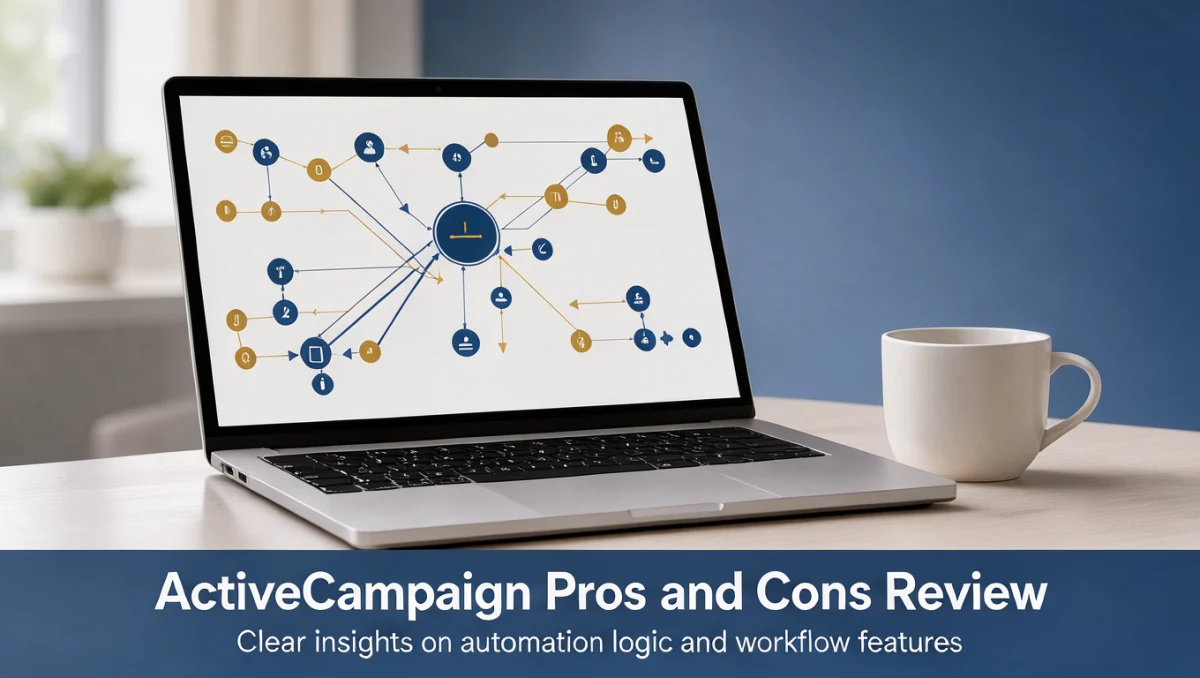
At the heart of the platform sits an intuitive yet sophisticated visual canvas. Administrators can build complex journeys containing conditional branches, delay steps, webhook triggers, and goal evaluations without writing manual code.
Because these sequences dynamically respond to live prospect interactions, automated onboarding funnels adapt instantly to prospect intent, sending targeted follow-ups based on behavioral cues.
Behavioral Tagging and Deep List Segmentation
Managing contact groups revolves around dynamic properties and automated tags. The software can immediately label subscribers based on custom events, site engagement, or form submissions.
This depth eliminates the hassle of designing duplicate campaigns, as dynamic content modules automatically adjust inside individual email messages depending on each contact's profile tags.
Connected CRM and Deal Pipeline Tracking
ActiveCampaign integrates email automation directly with sales pipeline tracking. Account executives can manage opportunity stages, record call notes, and schedule tasks across visual boards.
System logic can automatically shift deal stages or alert representatives when a prospect exhibits strong buying interest, creating a frictionless transition from digital nurturing to closed revenue.
Centralized Contact Interaction Histories
Every profile compiles a comprehensive historical record displaying past opens, page visits, submitted queries, and notes. This timeline gives customer-facing teams instant background before initiating direct outreach, ensuring communication remains contextual and data-backed.
Key Implementation Hurdles and Software Drawbacks
Despite its rich functional architecture, companies face specific hurdles during deployment that require practical workarounds.
Initial Technical Hurdle and Configuration Demands
The abundance of conditional logic gates and triggers can easily disorient novice users. Rushing deployment without adequate structural planning risks introducing conflicting automation rules and messy tag hierarchies.
Organizations can resolve this friction by blueprinting their tagging structures and workflows on paper before configuring them live. Launching simple, linear journeys first ensures team members understand the mechanics before deploying intricate branching trees.
Submenu Density for Occasional Users
Because the platform houses extensive functionality across settings, automation builders, reports, and contact records, casual users seeking to send quick announcements may find navigation cumbersome.
Establishing internal standard operating procedures and assigning primary system administration to specialized staff members helps prevent accidental modifications while keeping the environment orderly for basic users.
Ongoing Hygiene Demands for Database Tags
Because tags can be established dynamically from numerous forms and automations, contact databases can accumulate redundant labels over time. Without ongoing governance, audience selection can become confusing and prone to human error.
Instituting recurring quarterly audits, retiring outdated automations, and strictly adhering to centralized naming protocols prevents tag sprawl and preserves reliable list targeting.
ActiveCampaign Practical Feature Assessment

The summary below illustrates the functional benefits, limitations, and operational strategies for managing ActiveCampaign effectively.
| Operational Category | Primary Platform Advantage | Practical Platform Limitation | Recommended Management Approach |
|---|---|---|---|
| Automation Architecture | Flexible multi-branch customer journey sequences | Complex rule sets can conflict without careful oversight | Map conditional logic on paper before building workflows |
| Data Management | Dynamic tagging and behavioral custom fields | Taxonomy clutter occurs when tags are created haphazardly | Enforce strict naming conventions and conduct quarterly audits |
| Pipeline Alignment | Connected deal stages and automated task routing | Setup requires cross-department coordination | Align marketing and sales definitions before defining triggers |
| Platform Usability | Deep functional control over every contact touchpoint | Steep onboarding curve for non-technical team members | Create standardized workflow templates for recurring campaigns |
| Reporting Visibility | Detailed interaction histories on contact records | Aggregated reporting navigation requires platform familiarity | Bookmark core metrics dashboards and export regular summaries |
Target Audience Fit and Use Case Scenarios
Determining whether ActiveCampaign fits your business relies on team capacity, outreach volume, and functional expectations.
Solopreneurs and Independent Consultants
Independent service providers operating client booking pipelines and digital asset delivery can automate meeting notifications and lead vetting efficiently.
Nonetheless, individuals who merely require a basic broadcast platform for periodic newsletters will find the overhead and administrative configuration disproportionate to their actual output.
Growing Small Businesses
Small firms utilizing organized sales funnels benefit heavily from synced CRM deal tracking and behavioral email outreach, uniting marketing and sales without juggling separate software subscriptions.
Companies must dedicate at least one internal champion to govern system logic and data consistency, ensuring automations do not break as operations evolve.
Growth Marketers and Funnel Architects
Specialists orchestrating multi-channel acquisition funnels gain immense value from the platform's multivariate split-testing, behavioral dynamic content, and precise segmentation capabilities.
This functional flexibility facilitates the creation of complex lead-scoring models that automatically escalate warm prospects to sales teams.
Internal Administrative Units
Administrative teams running registration alerts and automated client onboarding can eliminate repetitive manual follow-ups using triggered communication paths.
However, basic company-wide announcements and internal chatter are far better served by traditional workplace productivity platforms without the overhead of marketing automation rules.
Academic Learners
Students exploring modern marketing funnels can leverage the system's architecture to grasp core principles of audience segmentation, lifecycle workflows, and CRM operations.
Even so, managing an ongoing commercial subscription is unnecessary for coursework; simulated environments or educational exercises generally suffice for learning the fundamentals.
Who Should Look Elsewhere
Businesses looking only for simple, unsegmented email distributions should steer clear of complex workflow engines. Straightforward email editors offer faster publishing with negligible maintenance.
Likewise, large enterprises with custom enterprise database architectures and heavy regulatory compliance needs should examine enterprise-grade customer data platforms tailored to their scope.
Common Buyer Questions
How should prospective buyers evaluate automation functionality?
Teams should clarify whether their campaigns require static mass broadcasts or behavioral, multi-path journeys. Visual builders with conditional routing excel in multi-step nurturing, whereas basic tools suffice for simple notices.
How can organizations manage growing database pricing tiers?
Review expected subscriber growth alongside the vendor tier thresholds on the pricing portal. Routine list pruning to remove dormant contacts keeps subscription overhead predictable and maintains high deliverability.
Why is structured onboarding necessary for workflow platforms?
Taking time to formalize naming conventions and test conditional routing before launching live funnels prevents broken triggers, tag collisions, and faulty messaging paths.
What peripheral costs should teams plan for?
Beyond baseline software subscriptions, teams should budget for creative design, copywriting, list verification tools, and administrative training to ensure a smooth transition.
Final Scorecard on ActiveCampaign
Our comprehensive evaluation confirms that ActiveCampaign remains a powerhouse for organizations focused on behavior-driven automation and CRM alignment.
| Criterion | Score /10 | Reason |
|---|---|---|
| Features | 9.0 | Offers deep workflow logic, conditional branching, dynamic tagging, and integrated deal pipelines. |
| Ease of Use | 7.0 | Presents a noticeable learning curve and complex navigation for casual campaign creators. |
| Pricing and Value | 7.5 | Delivers solid returns for active funnels, though buyers must review tier thresholds carefully. |
| Integrations | 8.0 | Connects smoothly with common external commerce, content, and form systems across standard stacks. |
| Audience Fit | 8.5 | Matches the requirements of small-to-medium teams focused on systematic lifecycle nurturing. |
| Support | 7.5 | Provides documentation and direct assistance channels that buyers should confirm on the official portal. |
| Competitive Position | 8.5 | Holds a strong functional posture against rivals like Mailchimp and HubSpot for automation-centric setups. |
Overall score: 8.0 out of 10
ActiveCampaign delivers tremendous leverage for companies seeking granular automation, robust segmentation, and organized pipeline management. If your operations center solely on basic periodic newsletters, select a less complex alternative. However, if sophisticated, triggered funnels form the backbone of your strategy, this software provides the exact structural precision required to scale.
For further advice on selecting software or tailoring your technology stack, get in touch with our team via our official contact page or connect with us on LinkedIn.