Tested Truth may earn a commission when you buy through links on this page, at no extra cost to you. This does not affect our ratings.
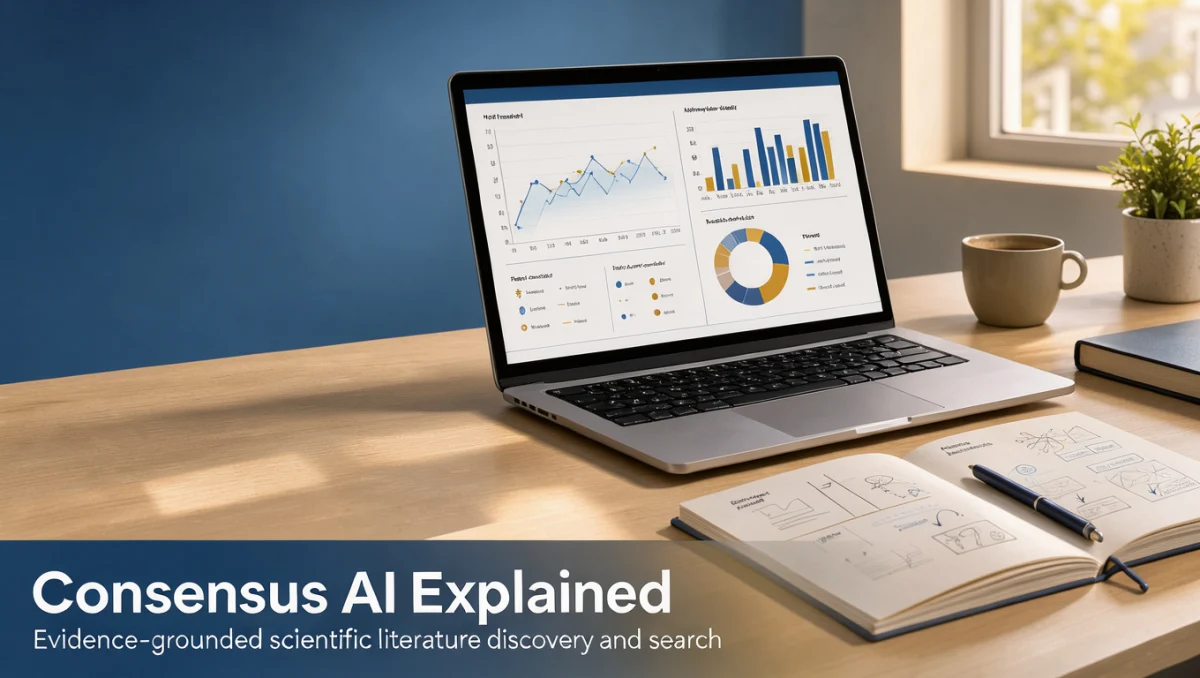
Put simply, consensus ai explained means an academic search engine built to pull answers straight from peer-reviewed scientific papers. It is designed for researchers, students, clinicians and analytical teams who want evidence-based answers without reading dozens of abstracts by hand. At Tested Truth, we judge how well this tool summarizes scientific agreement, organizes citations and slots into real research workflows.
Teams deciding whether the platform suits their research stack need a clear view of how it handles citation summaries and study extraction across different fields. Readers exploring the wider Artificial Intelligence discovery software space can use our neutral framework to compare literature search efficiency.
Quick verdict: Consensus AI scores 8.0 out of 10 for researchers who value direct citations from peer-reviewed publications. It suits research teams, healthcare analysts and academic writers who need evidence summaries, but it is a poor fit for anyone seeking creative prose or general web queries.
| Metric | Summary |
|---|---|
| testedtruth score | 8.0 / 10 |
| Best for | Researchers needing direct evidence extraction from peer-reviewed scientific studies |
| Not ideal for | Writers seeking long-form creative content generation or general web browsing |
| Key strengths | Evidence-grounded question answering, citation synthesis, scientific paper discovery |
| What to check before buying | Confirm user seat provisions, search credit caps, and export formatting rules on the official Consensus website |
1. How Tested Truth Reviewed Consensus AI
This review examines what Consensus AI is built to do, who it serves and how it compares with similar tools. We apply seven Tested Truth criteria: features, ease of use, pricing and value, integrations, audience fit, support and competitive position. Plans, prices and limits change often, so we flag what to confirm on the official website before buying. This article was researched and drafted with AI assistance, then reviewed and edited by the Tested Truth Editorial Team.
2. What Consensus AI Is and Who Needs It
Consensus AI is an evidence-based literature search engine that queries published scientific research to answer direct questions. Unlike general search engines that index promotional sites and personal blogs, it concentrates on peer-reviewed papers. The software analyzes study designs, outcomes and findings, then presents concise summaries backed by bibliographic citations.
The platform mainly serves academic researchers, clinical practitioners, science communicators, policy analysts and graduate students. By condensing study findings into direct answers, it reduces the manual effort of scanning journal databases. Readers of consensus ai explained guides will notice the tool is built around factual extraction rather than conversational improvisation.
3. Core Features of Consensus AI

3.1. Scientific Query Processing
Consensus AI interprets questions written in plain language and maps them against scientific literature. For queries about medical interventions, biological mechanisms or social policy, it identifies peer-reviewed papers that address the core research question.
3.2. Evidence Synthesis and Consensus Aggregation
A central capability is combining results from multiple papers into one aggregated view. The platform classifies whether selected studies report positive, negative or neutral outcomes on a given question, helping users gauge scientific agreement on debated topics.
3.3. Citation Tracking and Paper Extraction
Every claim links to its source publication, with author metadata, journal references and publication years. Users can inspect abstracts, methodology markers and sample sizes to verify claims independently.
4. Ease of Use and Learning Curve
The interface is straightforward, resembling a clean search portal where users enter questions and view cards summarizing papers. Many academic platforms require advanced Boolean operators, whereas this tool accepts natural questions, lowering the barrier for early-stage literature reviews.
Users still need to frame empirical questions well to get meaningful results. Speculative, philosophical or overly commercial queries return limited answers, so users must learn prompt phrasing grounded in empirical science.
5. Pros and Cons of Consensus AI
5.1. Advantages
- Direct grounding in peer-reviewed scientific literature reduces fabricated responses.
- Structured outcome classifications help users quickly see scientific agreement on contested topics.
- Citations accompany each summary point, speeding up bibliography building.
- Natural language input reduces reliance on complex database Boolean syntax.
5.2. Limitations and Mitigations
- Non-academic topics return sparse results because the index focuses on research literature; for general industry news, rely on traditional web databases.
- Synthesis quality depends on available publications; for emerging topics with limited research, supplement answers with manual library searches.
- Usage tiers on research platforms often cap automated summaries; confirm current query thresholds on the official vendor website.
6. Consensus AI vs Similar Tools

Consensus AI competes with other academic discovery applications such as Elicit and Scite. Scite concentrates on citation context, showing whether later papers support or dispute a finding, while Consensus AI emphasizes answering questions with aggregated research takeaways. Elicit focuses on structured workflow automation and custom column extraction from PDFs.
When choosing between these platforms, buyers should decide whether their workflow needs automated question answering across broad scientific literature or deep structured extraction from uploaded private PDF libraries.
7. Who Should Use Consensus AI
7.1. Academic Researchers and Graduate Students
Scholars conducting background literature reviews can speed up initial paper discovery and check whether consensus exists around experimental methods.
7.2. Clinicians and Healthcare Professionals
Medical practitioners looking for quick references to published clinical trials can review outcome summaries to support evidence-based decisions.
7.3. Content Strategists and Science Writers
Writers who need factual citations for educational articles can locate published studies without sifting through search advertising.
7.4. Teams That Should Look Elsewhere
Marketing teams seeking generative copywriting, code generation or informal chatbot conversation should choose general-purpose conversational tools rather than an academic discovery engine.
8. How to Choose the Right Plan
Subscription software in the research sector changes quickly. Use the checklist below to evaluate a subscription before purchasing.
| What to check | Why it matters |
|---|---|
| Search query quotas | Confirm monthly limits on automated synthesis runs to avoid unexpected workflow interruptions. |
| Citation export formats | Verify whether references export in your preferred format such as BibTeX, RIS, or plain text. |
| Team collaboration seats | Check whether sharing search folders across institutional co-authors requires higher tier subscriptions. |
| Access to full paper text | Determine how the platform handles paywalled content versus open-access journals on the official Consensus website. |
9. Frequently Asked Questions
9.1. How does academic query extraction differ from standard web search?
Academic search tools query curated databases of peer-reviewed journals rather than open web pages. This filters out commercial marketing, opinion blogs and unverified editorial claims, leaving results drawn from controlled studies, clinical trials and university research.
9.2. What should research institutions verify before buying multiple licenses?
Institutional buyers should verify seat administration tools, centralized billing and compliance terms directly on the official Consensus website. Confirm whether multi-seat licenses include shared research workspaces to avoid duplicate searches across teams.
9.3. How do researchers ensure citation accuracy when using automated summaries?
Cross-check each synthesized snippet against the original journal publication by opening the linked source. Verify sample sizes, experimental designs and statistical significance so synthesized findings accurately reflect the authors' conclusions.
9.4. When should a team consider alternative literature review platforms?
Consider alternative or complementary software when the main requirement involves processing private proprietary documents or running systematic reviews that need strict PRISMA workflow tracking.
10. Final Verdict
| Criterion | Score /10 | Reason |
|---|---|---|
| Features | 8.5 | Specialized literature synthesis and outcome consensus categorization deliver clear research value. |
| Ease of Use | 8.5 | Intuitive search bar allows natural language scientific questioning without complex Boolean strings. |
| Pricing and Value | 7.5 | Buyers should verify query allocations on the official Consensus pricing page to assess usage economics. |
| Integrations | 7.0 | Reference management export workflows should be confirmed against your institutional citation software. |
| Audience Fit | 9.0 | Precisely addresses the operational needs of literature reviewers, clinical analysts and graduate researchers. |
| Support | 7.5 | Review vendor help documentation and customer communication options on the official website before subscribing. |
| Competitive Position | 8.0 | Maintains a distinct profile focused on answering questions through peer-reviewed evidence aggregation. |
Overall Tested Truth score: 8.0 / 10
Consensus AI is a dependable research companion for professionals who need verifiable academic citations rather than unreferenced text. For further software comparisons or specific evaluation questions, contact the team at https://testedtruth.com/contact/ or follow Tested Truth on LinkedIn at https://www.linkedin.com/company/testedtruth/.